Imports in general in the domestic markets have certain sensitivities and subtleties, which not paying attention to them causes the waste of financial and human capital. Importing, like any other business, requires foresight, planning, familiarity with scientific methods, necessary action and gaining the trust of foreign buyers.
Product arrival steps
1) Introduction of import and how to start it
2) Finding the right supplier and market research
3) What is the process and steps of importing goods in customs and other authorities inside and outside the country? What is the import tariff?
4) Transportation and insurance
5) Import procedures in Iran
Iran’s import situation
In 2017, Iran had 49.9 billion dollars in imports and it was the 50th largest economy in the world in terms of imports. During the five years ending in 2017, Iran’s exports decreased by 0.6% annually, from 51.2 billion dollars in 2012 to 49.9 billion dollars in 2017. The highest amount of import belongs to the import of cars at the rate of 5.42%, followed by car parts at the rate of 3.42%.
Chapter 1) Introduction of import and how to start it
1. Definition of import of goods
Importing goods from other countries into the country is called importing goods. Imported goods are goods that are produced and supplied in different countries and then sold to another country through payment or exchange of goods. Import has a long history and goes back to the era of the first civilized countries about 4 thousand years ago. With the emergence of modern governments, import and export have taken a special order and made it possible for individuals, in addition to the government, to import goods according to the framework that the government determines for them.
2. Import in Iran
Imports play an important role in Iran’s economic market, so that the amount of 54 billion dollars in 2018 is considered for imported goods, and many people are working in this field. In many times when political problems lead to problems in paying money to foreign countries, various sectors in Iran face problems and this shows the importance of imports in Iran. Wheat, raw industrial materials and electrical parts are the main products that are imported into the country. The biggest exporter to Iran is China, which accounts for 35% of our country’s imports.
3. Risk identification and management
The types of risks are:
political risk*
legal – legal risk*
Quarantine – Quarantine compliance risk*
Exchange rate risk*
Non-payment risk*
logistic risk*
In addition to having many opportunities, importing also requires more risks. Although international trade environments have changed significantly over the years, the risks that importers face when purchasing their products and services from other countries remain.
The first step in managing import risks is clear and obvious – but sometimes it needs a detailed explanation: in the first step, you must first identify the source of the risk, then try to minimize it.
The next step is choosing partners and proper professional import advice, which plays an important role in reducing these risks. Your banking and foreign exchange consultant, international law consultant and lawyers, insurance consultant and transport operators and shipping companies and customs brokers and clearance agents should also be able to inform you about the risks that may occur in foreign markets with If you encounter them, let them know.
Chapter 2) Finding the right supplier and market research
Found the right supplier:
1. Using the Internet to find foreign buyers
2. Attending exhibitions or using international exhibition sites
3. Through attendance at business boards
Using the Internet to find foreign buyers:
B2B You can access the list of reliable websites in this field by searching the Internet with the keywords website, B2B directory, exporter directory, etc.
To check the rank of the domain name, enter it on the Alexa website and view its details. Sites whose global ranking is lower than 100,000 are suitable for starting. The closer the site rank is to 1, the more visitors the site has.
It is mentioned: B2B in the following section to some sample sites
http://www.alibaba.com
http://www.ecplaza.net
http://www.kompass.com
http://www.tradezone.com
http://www.hktdc.com
http://www.ec21.com
http://www.ameinfo.com
http://www.exportbureau.com
http://www.globalsources.com
http://www.worldbid.com
http://www.tradeKey.com
http://www.etradeasia.com
http://www.b2bfreezone.com
http://www.importers.com
http://www.toocle.com
http://www.tpage.com
http://www.ttnet.net
Attending exhibitions or using international exhibition sites:
International exhibitions are one of the best marketing sources for communicating with foreign partners, participating in international exhibitions. To find out about the calendar of international exhibitions, you can access the list of desired exhibitions by referring to the following websites.
http://www.auma.de
http://www.tsnn.com
http://www.expodatabase.com
http://www.eventseye.com
By attending business boards:
Trade and marketing boards: It is one of the appropriate levers to find a supplier. Undoubtedly, by sending a business delegation abroad, compared to individual business trips, negotiations can be given more depth, and the supervisors and officials of such delegations, if they have sufficient experience andChoosing and implementing useful and productive programs can lead to interesting initiatives even in the first trip and meeting and negotiating with commercial and Iranian parties that will lead to the conclusion of definite and real commercial contracts.
Pricing
The pricing of imported goods is different from the domestic pricing: the foreign market situation, the different costs of import procedures, different pricing strategies and different currencies have an effect on the cost you receive from your customers for your service or product.
The pricing of each market requires:
*Knowledge of variable costs
* Knowing the amount of demand
* Knowing the level of competition in the target market
Import includes 2 types of costs: fixed and variable
Fixed costs:
– Research in international markets
– Travel to foreign markets
– International communication
– Reviewing research (including translation of research)
– Change in product or service
– Packaging and labeling of products
– Product liability insurance or other insurances
– Compatibility with internal standards
– Financing costs
– Promotional expenses
Variable costs:
Receiving imported cargo in the country
Air or sea receipt fee and insurance policy
Import tax
Intermediary fee and settlement with the goods supplier
Ground transportation from the port to your warehouse
Warehouse costs
The cost of using rental warehouses
Agent or importer commission
Therefore, even with experience in the field of import, pricing is one of the most difficult challenges for importers.
Chapter 3) What is the process and steps of importing goods in customs and other authorities inside and outside the country? What is the import tariff?
Procedures for importing goods into the country:
1. Knowing the target product
2. Knowing the manufacturer
3. Physical examination of goods
4. Time estimates
5. Contact the supplier
6. Customs and legal procedures for importing goods
7. Calculation of costs
8. Business card
9. Obtaining permits
10. Payment to the producing company
11. Production
12. Goods clearance
13. Registration of declaration for discharge
14. Product inspection
15. Payment of taxes and duties
16. Presentation of documents
17. Payment of goods clearance
18. Attorney
19. Receiving goods
Customs tariff or commodity tariff
Tariffs are taxes and duties that governments levy on imported or exported goods for protective, financial or combined reasons. The customs tariff may be charged based on the value of the goods, in which case it is called ad valorem tariff and is calculated and charged in different ways. Tariffs have different types, we will discuss some of them below.
a) Tariff means the product’s position in the classification HS
The tariff means that it is announced at the customs during the declaration of goods or when receiving permission from other legal authorities, such as registering an order.
b) Tariff means the amount of duties and taxes for the goods during the declaration and clearance of the goods at the customs. In this definition, merchants are looking for the basis for calculating duties and customs duties.
Chapter IV) Transportation and Insurance
Types of shipping methods:
1. Maritime transport
2. Rail transport
3. Road transport
4.Air transport
5. Mail
6. Multimodal transport
Insurance
Insurance is a contract by which one party undertakes to receive money from the other party and in case of an accident that leads to damage to the goods in question, to compensate for the damages caused to the goods or to pay him a certain amount. The obligee is called the insurer, the beneficiary is called the insured, and the subject of the insurance is called the insured.
Transport insurance policy: It is a guarantee that assumes the risks caused by transportation and compensates the damage caused to the goods to the extent of the insurance coverage.
Three conditions of marine insurance policies:
1. Full risk condition
2. Specific damage condition
3. Special damage exception condition
According to the type of goods and its condition, the owners of goods choose one of these conditions to cover their goods.
Chapter 5) Imports in Iran
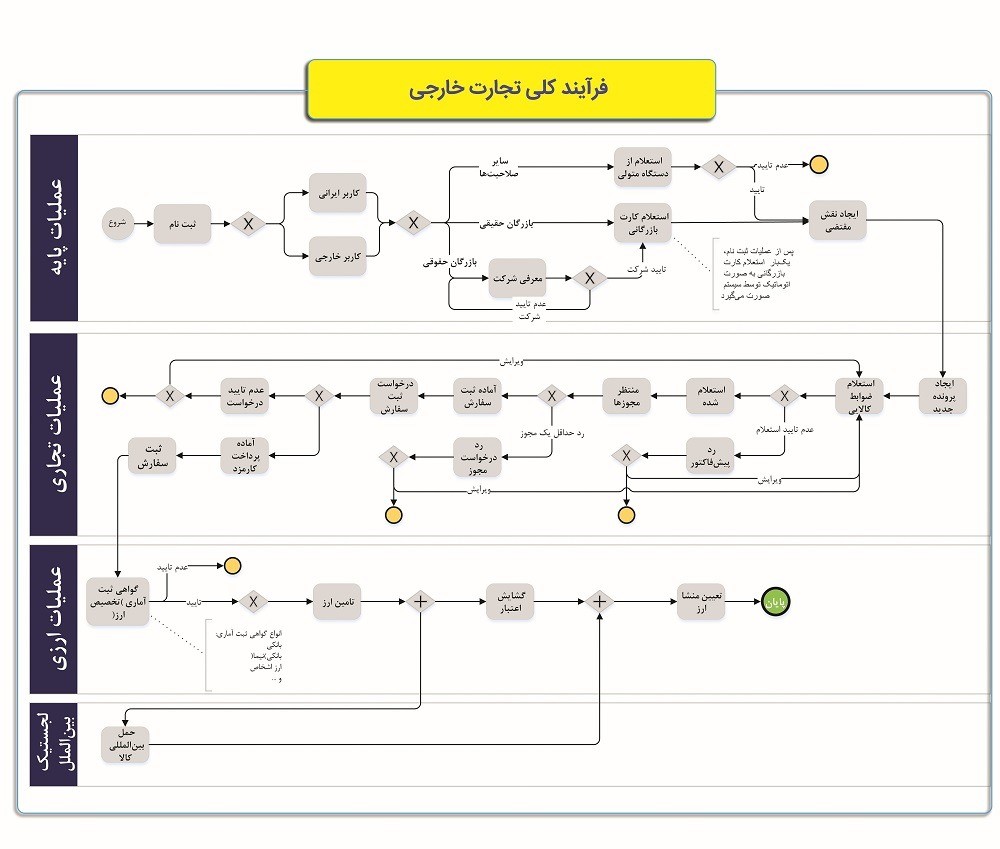
Declaration documents and attachments:
1. Warehouse bill
2. Clearance
3. Bill of lading
4. Baling
5. Insurance
6. Certificate of origin
7. Weight certificate
8. Certificate of analysis according to the case
9. Inspection certificate
10. Invoice
11. Proforma
12. Health certificate (as applicable)
13. Standard certificate as the case may be
14. Photocopy of business card
15. Photocopy of economic code
16. Photocopy of exploitation license
17. Photocopy of work permit card (for work permit)
18. Entry permits as the case may be
19. Currency sale announcement
20. Catalog, brochure
Frequently asked questions
Discharge document
A clearance document is a document by which goods can be removed from customs, such as a customs license for commercial goods and a permit for non-commercial goods.
Complete discharge
Complete clearance is the definite clearance of the goods, where the evaluation operation is performed on the vehicle and its formalities are not definite.
Transit goods
Transit goods are the goods that are transferred from the anchorages or ports or airports of the country from one ship to another ship, from one plane to another plane.
Abandoned item
Abandoned goods are goods whose owner did not go to the customs office for any reason, or if he did go to the customs office, he delayed in presenting the necessary documents, or the goods were abandoned due to the lack of special permits required.
In the airports of the country after two months and in other customs places after four months of suspension from the date of issuance of the first invoice, the goods will be abandoned. After this period, with the agreement of the customs, it can be extended up to another four months (in land and sea customs) and up to two months in airport customs.
Conditional goods
Conditional goods are goods whose entry needs to be fulfilled as stipulated in the table column of the annual export and import regulations or the contents of the tariff notes.
Allowed goods
Permitted goods are the goods that are required for entryThere is no need to fulfill the condition
Prohibited materials
There are goods whose entry is prohibited by special laws and approved by the Islamic Council or within the framework of Islamic holy law.
Do entry permits have to be obtained and submitted when placing an order?
Licenses can be provided in two ways
a) At the time of order registration, the relevant licenses are obtained and submitted to the Ministry of Commerce, and the order registration form is sealed with the seal of the relevant ministries, and the Ministry of Commerce issues the order registration based on the relevant licenses.
b) The necessary permits are not submitted to the Ministry of Commerce at the time of order registration, but these permits must be submitted to customs at the time of clearance.
Do other licenses need to be obtained for the import of goods besides order registration?
If in the attached tables of export and import regulations, the entry of goods is subject to obtaining a license other than the license of the Ministry of Commerce, in addition to registering the order, the required licenses must also be obtained. Otherwise, if the entry of the goods is only subject to the permission of the Ministry of Commerce, it is sufficient to register the order. In addition, if legal permits are needed, they must be obtained and submitted.
Do you need a commercial card to enter the product as a sample?
No, entering goods as a sample does not require a commercial card.
Is the invoice provided by the owner of the goods used as a criterion for the valuation of the goods?
If the value stated in the invoice is found to be appropriate and real (according to the clearance records of the similar product), it will be accepted.
What are positive customs documents?
Positive customs documents include customs entry permit, passenger pass (customs pass), deposit receipt by which goods are released, purchase receipt from customs, internal transit pass, foreign transit permit, cabotage permit, return goods permit. Temporary entry permit, temporary issuance.
If the declaration is submitted to customs, can it be requested to be amended?
The owner of the goods or his legal representative can make a written request to amend the declaration, but its acceptance by the customs depends on the fact that the evaluation operation of the goods subject to the declaration has not started.
How long does the goods stay in the customs warehouse?
The period of stopping goods in warehouses or customs facilities at land borders is 4 months, which can be extended by another 4 months at the request of the owner of the goods, and at air borders by 2 months and by another 2 months at the request of the beneficiary.